Standard Reading Time: 5 minutes
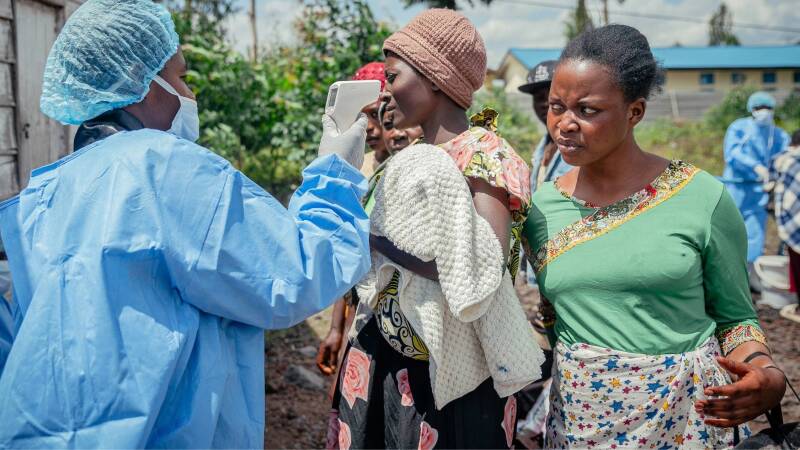
image by Anadolu via Getty Images [i]
While the world looks elsewhere, eastern Congo is fighting two emergencies at once.
In 2026, the Democratic Republic of the Congo (DRC) is battling the fastest-growing Ebola outbreak ever recorded. It is spreading through the same provinces that war has torn apart for decades.
A virus is spreading. Fighting is spreading. Aid is running out. And children are caught in the middle.
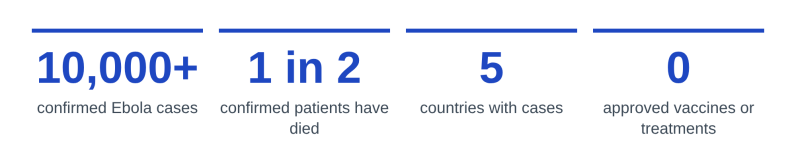
Two Crises, One Region
The DRC's emergency is not one disaster. It is two, and they feed each other:
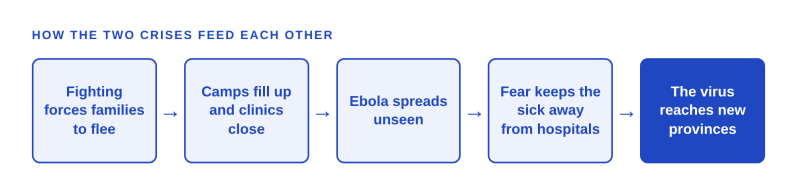
Each step makes the next one worse. Families who flee the fighting end up in crowded camps, where one sick person can pass the virus to many others. Clinics that close after attacks cannot test or isolate patients. And when people fear soldiers, rebels or rumours, they hide their symptoms instead of reporting them.
On top of Ebola, the region is carrying three other emergencies at the same time:
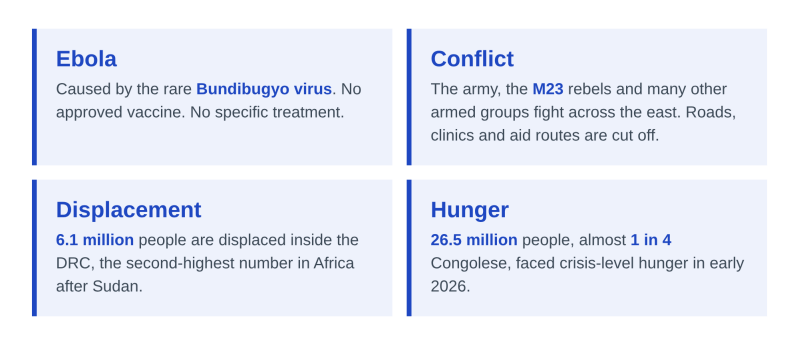
This is not a single crisis. It is a collision.
The Fastest-Growing Ebola Outbreak in History
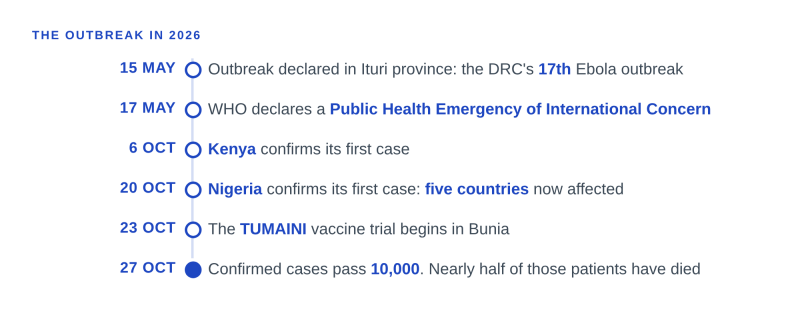
It started in one province. Five months later, it has crossed borders.
Ebola spreads through close contact with the blood or body fluids of someone who is sick or has died from it. Early symptoms, like fever, tiredness and headache, look a lot like malaria, so many cases are missed at the start.
This outbreak is caused by Bundibugyo, a rare type of Ebola. It has caused only two outbreaks before: Uganda in 2007 and the DRC in 2012. That matters, because the vaccine that helped end recent outbreaks was made for a different type of Ebola. It does not protect against this one.
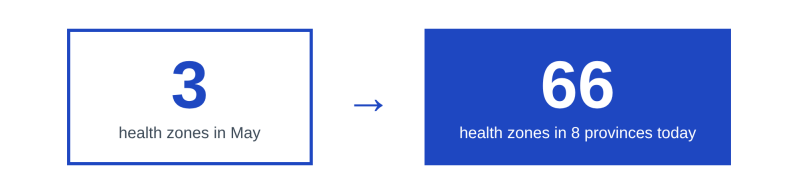
In May, cases were limited to three health zones in Ituri. Today, the virus is active across a huge part of the country:
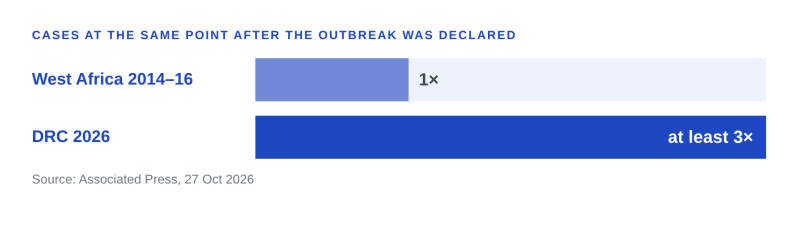
Compared with the same point in the 2014–2016 West Africa epidemic, previously the worst Ebola outbreak ever, this one has at least three times as many cases and deaths.
The virus is also travelling. In Kenya, the first patient flew into Nairobi after travelling from the DRC through Uganda. Eight more people, including four health workers, caught it from him. In Nigeria, a patient fell ill four days after arriving in Abuja.
There are moments of hope too. More than 2,600 people have recovered, and a video of health workers in full protective suits dancing as the last two patients left a treatment centre in Mongbwalu went viral this week.
Every recovery shows that early care saves lives.
The problem is reaching people in time.
Why Can't It Be Stopped?
Stopping Ebola means finding every case and every contact. In eastern Congo, that is almost impossible:
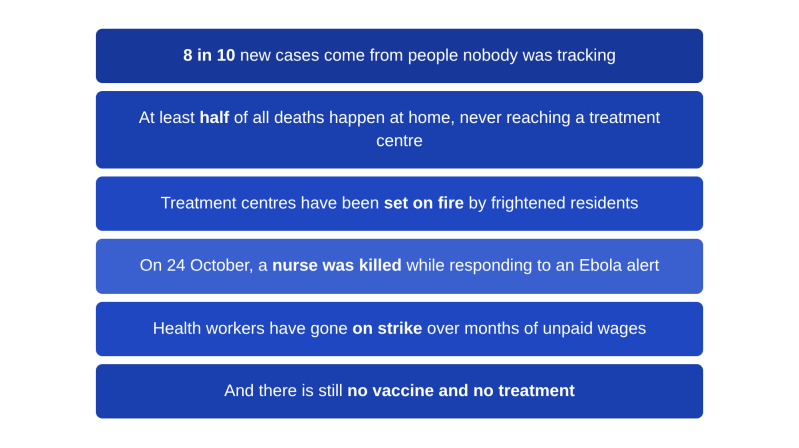
Contact tracing is the backbone of any Ebola response. Health teams aim to check on 95% of known contacts every day. In late October they reached about 80%, and in North Kivu only 73%.
Fear makes this harder. After years of war, many families do not trust outsiders, and rumours spread faster than facts. When a treatment centre is seen as a place where people go to die, families hide sick relatives and bury them in secret. Unsafe burials are one of the main ways Ebola spreads.
Ebola is also pulling care away from everything else. Childhood vaccinations have been disrupted. Cholera gets less attention. In some provinces, maternal deaths doubled as pregnant women stayed away from hospitals out of fear.
The virus is not only killing people.
It is shutting down the health system around them.
Decades of War
Ebola arrived in a region that has barely known peace in thirty years.
Eastern Congo is rich in gold, tin and coltan, a mineral used in phones and laptops. Control of mines and trade routes has fuelled fighting between dozens of armed groups for decades. The people living on top of that wealth are among the poorest in the world.
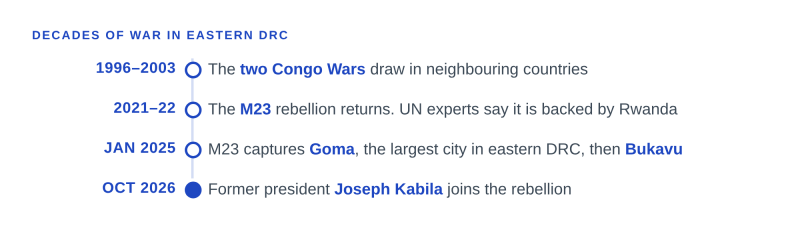
Every new offensive forces families to flee again. Many have been displaced more than once. Each time, they leave behind their homes, their fields and the local clinics that knew them.
In Ituri alone, nearly 1 million people were already displaced before the virus arrived.
Overcrowded camps. Broken clinics. Deep distrust. The perfect conditions for an epidemic.
Children at the Center of this Crisis
Children are paying the highest price.
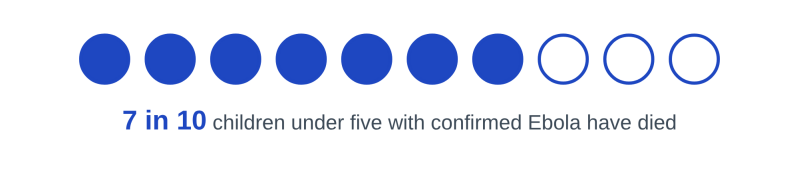
- 2,076 children confirmed with Ebola by the end of September. 1,162 of them died.
- 1,900+ children have lost or been separated from a parent or caregiver.
- 4.18 million children under five need treatment for acute malnutrition.
When a parent is taken into an Ebola treatment centre, young children are often left with no one to look after them. Some move in with relatives. Others face stigma, as neighbours fear they might carry the virus. Many have also missed months of school and routine vaccinations.
UNICEF now runs 12 nurseries next to Ebola treatment centres, for young children whose parents are sick or have died. One of the caregivers, Neema, is a medical student who caught Ebola while working with children. She survived, and now looks after the children the virus has left on their own.
A Response Running on Empty
The WHO, UNICEF, MSF, the IRC and the Red Cross are on the ground. They test patients, trace contacts and carry out safe burials. A new vaccine trial, TUMAINI, offers the first real hope.
But the money is not there.
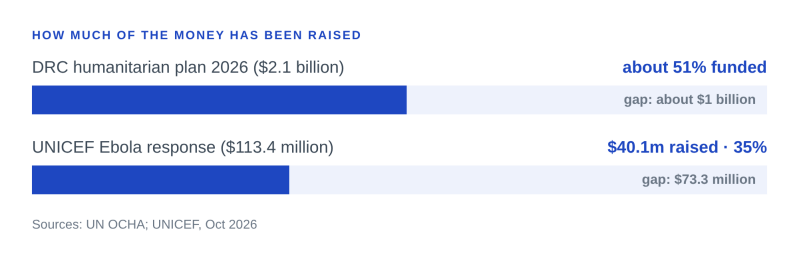
The gap has real consequences. Without money, health workers go unpaid, contact tracers cannot reach remote villages, and nurseries cannot open. Across the country, 18.5 million people need humanitarian help, but the UN plan can only aim to reach about 8.1 million of them.
Scientists are racing to build a vaccine.
The world is not racing to pay for the response.
Join Us in Making a Difference
Ebola spreads through silence and fear. Information is one of the strongest tools against it.
You do not need to be a doctor to help. Most of what slows an outbreak is simple: accurate information, trust, and money that arrives on time.
How You Can Help
- Educate Yourself and Others: Understanding the crisis in the DRC is the first step. Learn about the situation and share this knowledge with friends, family, and your community. Awareness is the first step toward action, and by spreading information, you help keep this issue in the spotlight, encouraging more people to get involved.
- Raise Awareness: Share this post on social media to spread awareness about the crisis in the DRC. Help fight misinformation about Ebola by sharing reliable sources such as the WHO and UNICEF.
- Donate to Humanitarian Organizations: Organizations like UNICEF, Médecins Sans Frontières (MSF), and the IRC are on the ground treating patients and protecting children. Your donations can help provide care, protective equipment, and support for families affected by Ebola and conflict. The children need you.
- Advocate for Policy Action: Use your voice to call for greater humanitarian funding and protection for civilians and health workers in the DRC. Join with others and urge governments and international bodies to fully fund the Ebola response.
- Support Refugees: More than 1.2 million Congolese refugees have fled to neighbouring countries such as Uganda, Burundi, and Rwanda. Support initiatives that provide shelter and resources to displaced populations.
- Engage in Fundraising: Community-led fundraising efforts can provide significant contributions to organizations working on the ground. Host a fundraiser within your local community, school, or workplace to collect funds for relief efforts. Find more information on the organizations you can direct your profits to in the affiliate links below.
- Pray: If you are religious or spiritual, consider holding the Democratic Republic of the Congo and its people in your thoughts and prayers.
Affiliate Links on How to Help
[i] Sales, D. (2026, May 27). Ebola-hit DR Congo faces “catastrophic collision” of disease and conflict, WHO warns. BBC News. https://www.bbc.co.uk/news/articles/cdxpdex062yo
[ii] Associated Press. (2026, October 27). Congo’s Ebola outbreak tops 10,000 cases as authorities race to slow the spread in African countries. CP24. https://www.cp24.com/news/world/2026/10/27/congos-ebola-outbreak-tops-10000-cases-as-authorities-race-to-slow-the-spread-in-african-countries/
[iii] World Health Organization. (2026, October 23). Ebola disease caused by Bundibugyo virus – Democratic Republic of the Congo, Kenya and Nigeria. WHO Disease Outbreak News. https://www.who.int/emergencies/disease-outbreak-news/item/2026-DON622
[iv] UNICEF. (2026, October 6). More than 1,900 children orphaned or separated from their families by Ebola in eastern DR Congo. UNICEF. https://www.unicef.org/press-releases/more-1900-children-orphaned-or-separated-their-families-ebola-eastern-dr-congo
[v] UNICEF. (2026, October 6). “Ebola takes the people children depend on and unravels their lives.” UNICEF. https://www.unicef.org/press-releases/ebola-takes-people-children-depend-and-unravels-their-lives-unicef
[vi] UN OCHA. Democratic Republic of the Congo. OCHA. https://www.unocha.org/democratic-republic-congo
[vii] FAO & WFP. (2026, May 13). Millions trapped in deepening hunger crisis in the DRC as needs far outpace humanitarian response. FAO. https://www.fao.org/newsroom/detail/millions-trapped-in-deepening-hunger-crisis-in-the-drc-as-needs-far-outpace-humanitarian-response/en
[viii] UNHCR. (2026). The Democratic Republic of the Congo (DRC): Global appeal 2026 situation overview. UNHCR. https://www.unhcr.org/sites/default/files/2026-01/ga2026-drc-situation.pdf
[ix] UNHCR. (2026). DRC at a glance, 31 March 2026. ecoi.net. https://www.ecoi.net/en/file/local/2139546/COD_DRC_at_a_glance_31_March_2026_A3L.pdf
[x] Agence Congolaise de Presse. (2026, October 12). DRC: 6.1 million internally displaced people at the heart of the Congolese plea in Geneva. ACP. https://acp.cd/anglais/drc-6-1-million-internally-displaced-people-at-the-heart-of-the-congolese-plea-in-geneva/
[xi] International Crisis Group. Democratic Republic of Congo. Crisis Group. https://www.crisisgroup.org/africa/great-lakes/democratic-republic-congo
[xii] Al Jazeera. (2026, October 14). Ex-DRC president Kabila’s alliance with M23 rebels: Why it matters. Al Jazeera. https://www.aljazeera.com/news/2026/10/14/ex-drc-president-joseph-kabila-joins-hands-with-m23-rebels-why-it-matters
[xiii] Al Jazeera. (2026, May 21). Ebola tensions rise as treatment centre torched in DR Congo’s Ituri. Al Jazeera. https://www.aljazeera.com/gallery/2026/5/21/ebola-tensions-rise-as-treatment-center-torched-in-congos-ituri
[xiv] Associated Press. (2026). Attacks on Ebola treatment centers are one of several problems affecting Congo’s outbreak response. ABC7 New York. https://abc7ny.com/post/ebola-update-today-attacks-treatment-centers-are-several-problems-affecting-congos-outbreak-2026-response/19162457/
[xv] People Daily. (2026). DRC humanitarian crisis: 18.5M people need aid amid funding gaps. People Daily. https://peopledaily.digital/news/drc-humanitarian-crisis-18-5m-people-need-aid-amid-funding-gaps
Add comment
Comments