Standard Reading Time: 3 minutes
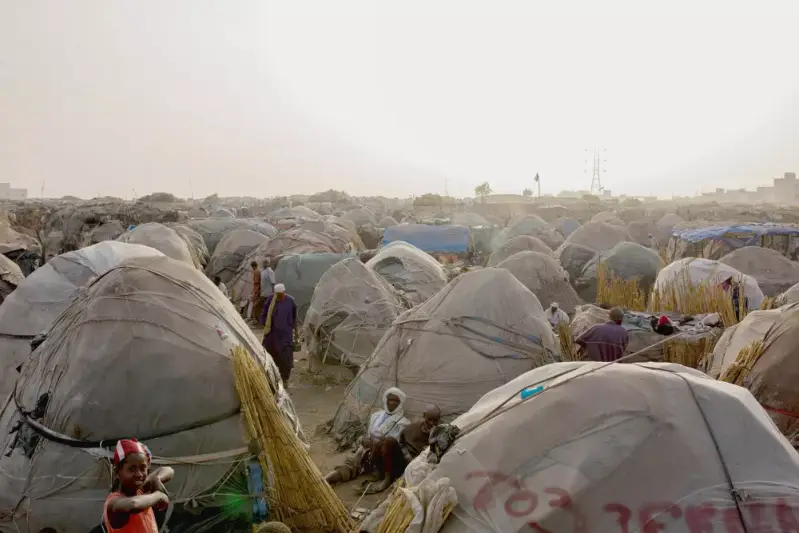
"Hundreds of IDPs from central Mali are living on a landfill site next to a livestock market in the capital, Bamako," Image by Kleinfeld [i]
While the world debates high profile crises, Mali is quietly collapsing.
In 2026, Mali ranks among the world’s most severe, yet least reported, humanitarian crises. Violence is spreading. Hunger is intensifying. Aid is shrinking. And millions are trapped in the middle.
A Country Under Pressure
Mali’s crisis is not caused by one single event.
It is the result of overlapping shocks.
Mali’s crisis is complex because it is layered. Armed groups have expanded their control across major trade routes and rural regions. Insecurity continues to destabilize northern and central areas, with violence increasingly affecting parts of the south and west. At the same time, climate shocks, such as severe flooding and drought, are destroying farmland and displacing communities. These pressures feed into each other:

Cutting Off Essential Services
Armed groups, including Jama'at Nusrat al-Islam wal-Muslimin (JNIM), have targeted major roads and trade corridors.
These highways supply up to 95% of Mali’s fuel.
When they are blocked or attacked, the consequences extend far beyond transportation:
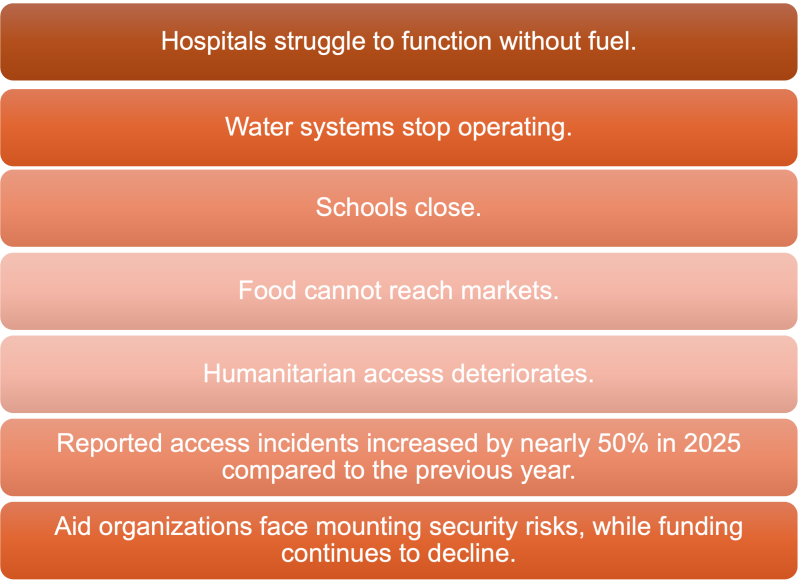
In other words, assistance is becoming both harder to deliver and harder to finance.
Displacement on a Massive Scale
As of late 2026, over 414,584 people were internally displaced across Mali. More than half of them are women and girls. Many displaced families now live in temporary settlements with limited protection, insufficient sanitation, and restricted access to healthcare. Displacement is driven not only by armed conflict and intercommunal violence, but increasingly by flooding and environmental degradation.
Unlike some crises, there are few truly safe areas within the country. Movement does not guarantee security. It often simply exchanges one vulnerability for another.
Children at the Center of this Crisis
Children are bearing the heaviest burden.
- Approximately 1.5 million children under five are suffering from acute malnutrition.
- More than 2,320 schools have closed due to insecurity, affecting over 696,000 children and 13,900 teachers.
- When schools close, children do not just lose education. They lose protection, stability, and in many cases daily meals.
Malnutrition, interrupted learning, and exposure to violence create long-term consequences that extend far beyond the immediate crisis.
Without sustained intervention, an entire generation risks growing up without the tools necessary to rebuild their country.
Hunger Is Intensifying
Even before the latest escalation, 1.5 million people were facing serious food shortages. Agricultural disruption — caused by conflict, insecurity, and flooding — has led to significant declines in food production, with some areas experiencing up to 30–40% losses.

This is not just about hunger.
It is about the risk of famine in communities already stretched beyond capacity.
A Crisis Starved of Funding
Humanitarian partners are seeking $551 million in 2026 to assist 3.8 million people. Yet Mali’s response has been chronically underfunded, with only 16% of 2025 requirements met.
Funding gaps are not abstract budget figures. They translate directly into:
- Reduced malnutrition treatment
- Fewer protection services for survivors of gender-based violence
- Interrupted healthcare and education programs
At the same time, local organisations implementing life-saving programs face disruption due to financial shortages.
Mali’s crisis is not only driven by conflict and climate.
It is also deepened by neglect.
Join Us in Making a Difference
Mali’s crisis is deepened by neglect, which means attention itself is a form of help.
- Educate Yourself and Others: Mali is one of the world’s most under-reported crises, and that silence costs lives. Learn about the situation and share what you know with friends, family, and your community. Awareness is the first step toward action, and the more people talk about Mali, the harder it becomes to ignore.
- Raise Awareness: Share this post on your Instagram story, in your group chats, or on any platform you use. Every share puts Mali in front of someone who may never have heard about this crisis.
- Donate to Humanitarian Organisations: Organisations like UNICEF, the World Food Programme (WFP), and the International Rescue Committee (IRC) are on the ground in Mali, providing food, malnutrition treatment, healthcare, and protection. With the response only 23% funded, every donation matters. Even a small amount can help treat a malnourished child.
- Advocate for Policy Action: Use your voice to call for greater humanitarian funding and protection for civilians in Mali. Contact your local representatives, sign petitions, and urge governments and international bodies not to let Mali fall off the agenda.
- Support Refugees: Hundreds of thousands of Malians have fled to neighbouring countries such as Mauritania. Support initiatives that provide shelter, food, and education to displaced families.
- Engage in Fundraising: Host a bake sale, sponsored walk, or fundraiser at your school, university, or workplace. Community-led efforts can make a real difference to organisations working on the ground. Find the organisations you can direct your profits to in the affiliate links below.
- Pray: If you are religious or spiritual, consider holding Mali and its people in your thoughts and prayers.
Affiliate links on How to Help
[i] Kleinfeld, [First name]. Hundreds of IDPs from central Mali are living on a landfill site next to a livestock market in the capital, Bamako. The New Humanitarian, www.thenewhumanitarian.org/photo-83. Accessed 23 Oct. 2026.
[ii] “Mali.” Humanitarian Action, UN OCHA, 2026, humanitarianaction.info/plan/1511/article/mali-4. Accessed 25 Oct. 2026.
[iii] “Humanitarian Crisis Analysis 2026: Mali.” Sida, Swedish International Development Cooperation Agency, 31 Mar. 2026, cdn.sida.se/app/uploads/2026/04/22144214/Mali-HCA-2026_March-2026-Short.pdf. Accessed 26 Oct. 2026.
[iv] “One Month into Escalating Violence, Mali Families Face Humanitarian Catastrophe.” The IRC, International Rescue Committee, 25 May 2026, www.rescue.org/press-release/one-month-escalating-violence-mali-families-face-humanitarian-catastrophe. Accessed 27 Oct. 2026.
[v] “Mali Hosts More than 322,000 Refugees and Asylum Seekers.” Africanews, 14 Oct. 2026, www.africanews.com/2026/10/14/mali-hosts-more-than-322000-refugees-and-asylum-seekers/. Accessed 26 Oct. 2026.
[vi] “Mali Appeal: Humanitarian Action for Children.” UNICEF, 2026, www.unicef.org/appeals/mali. Accessed 27 Oct. 2026.
[vii] “Humanitarian Action for Children 2026: Mali.” UNICEF, 2026, www.unicef.org/media/179331/file/2026-HAC-Mali.pdf. Accessed 24 Oct. 2026.
[viii] “Mali : Bamako cherche des solutions durables pour les déplacés.” APA News, fr.apanews.net/disasters/mali-bamako-cherche-des-solutions-durables-pour-les-deplaces/. Accessed 24 Oct. 2026.
[ix] “Mali : le plan humanitaire financé à seulement 23 %.” APA News, fr.apanews.net/society/mali-le-plan-humanitaire-finance-a-seulement-23/. Accessed 24 Oct. 2026.
Add comment
Comments